Try Audible Free For 30-days

Sunday, May 7, 2017

Dawn by Octavia E. Butler: Review

Dawn (Xenogenesis, #1)Dawn by Octavia E. Butler
My rating: 4 of 5 stars

First thing is first. Dawn, by Octavia Butler has one issue in that it sometimes over explains, labors too much on a point or returns to it again and again. In that, this book can sometimes be frustrating, slow, a bit of a slog, and so on.

However, these parts are sparse enough and the ideas and characterizations within it are powerful enough to make these dull bits easier to plow through.

So then, tell me, if the world were going to end, humanity about to exterminate itself, and you woke to find yourself saved, cured of a gene that would lead you to your own demise, by some alien race, and all that was asked was that you would be changed and be used for their purpose, how would you feel? Would you find this to be a fair trade? Would you rebel? Would you kill yourself, or struggle on, even if that meant the end of the human race as it was absorbed into another, jellyfish like race?

These are a few of the questions at the heart of this novel, the first in a series. When Lilith finds herself as the chosen leader of a group of humans, being trained and taught to do this, she must confront these questions. In this story, she is given so much, is even treated kindly, yet there is some insidious nature to it. As if her alien captors, despite their kindness, view her and humanity at large, as somehow lesser, as pets, as subhuman.

Even as they change her and give her more freedom they ignore her reluctance, telling her again and again that she will choose to obey their wishes. Even as she holds onto this reluctance she knows her only chance is the return to earth, where humankind may live or die by its own hand.

Naturally I cannot speak to Butler's intentions when writing this novel, I know little enough about her on the whole and, very tragically, she died young. However, what I really got from this novel is an exploration of what it feels like to be in a society where, perhaps you are not treated as we might classically associate as slaves being treated, but nonetheless, the characters are treated as slaves. As property, their autonomy denied in favor of a select gene.

Even Lilith's gain of freedom and power is just reward for being a good slave. She does as she is told and learns well. Even what love she might feel for one of her captors seems to be, on some level, a calculated necessity for survival.

It is apt then, that Butler choose a black woman to represent these experiences, to better convey the horror and dehumanization that goes hand in hand with being altered as greatly as she is. Indeed, this book is both unbelievably smart and intensely horrifying. A truly great read that everyone should take part in.

View all my reviews

Wednesday, May 3, 2017

The Red Tree by Caitlin R. Kiernan: Review

The Red TreeThe Red Tree by CaitlĂ­n R. Kiernan
My rating: 4 of 5 stars

This book. This fucking book. It was, without a doubt, one of the most horrifying reads that I've ever had the pleasure to sit in a corner, cowering, and enjoy. And not just because of the Lovecraftian weirdness or the Poe style atmosphere being built up over the course of the novel. No, not simply for that.

The plot to this story is a fairly easy to follow one. Sarah Crowe, amidst her seizures and guilt over the suicide of her lover, Amanda, and her own writer's block, has moved to Providence. She has moved into a small country house and is living there, dirt poor, and chronicling her experiences, thoughts, memories, and feelings into a journal.

Simple enough set up. But then things start getting weird. Real weird. And I'm not enough of an asshole to spoil it here so if you want to know then you are going to have to simply hop on over to amazon or go to a book store and buy this beautiful book.

So then, if I'm not willing to get into the oddities of this little gem, if I'm not willing to spoil the impossibilities there within to illustrate just how horrifying this book was to me, how do I convey it? Simply enough, actually. By talking about the other thing this book has going on, by talking about the insight that Kiernan has when it comes to the experience of being a writer.

First there are a few things I want to get out of the way. Namely this: Kiernan has a philosophy when it comes to her writing and that is that she does not believe that horror is a genre so much as an emotion, an feeling experienced and boy does she do well at having her characters--and readers--experience just that. The other thing is that this novel is rife with references to other literature, some of which is obvious, being quoted, some more subtle, and though I've not read nearly enough to say for certain, I get the feeling that some of our character, Sarah Crowe's experiences and feelings on her own writing can be reflected back onto Kiernan herself.

But, much like the character of this novel, I digress.

The thing that really made this book hit home for me was that Sarah Crowe, miserable old bitch though she might be, is somewhere near my own heart. As a writer myself I can attest to that abject misery that comes along with the writing process. Do not misunderstand, I love doing it, in a sick sort of way. In the way that someone might have a fetish for pain to I have a fetish for writing and by god does it terrify me to be in a state where the well has run dry.

I think Bukowski said it best in his poem, "So you want to be a writer," something along the lines of, "Unless being still would drive you to madness of murder." That's what its like, I think. That's the feeling of it. But if it were to run dry, then all you have left is that slow descent into bitterness and madness.

That's what Sarah Crowe had waiting for her, except she was already bitter. And that's frightening. Having nothing left within you to expunge, having nothing but your own need to be right, and your own bitterness. Having all that was good behind you and the only thing waiting for you up ahead is a slow fall into madness.

So, read this book. It is damn good.

View all my reviews

Friday, December 30, 2016

Annihilation by Jeff VanderMeer

Annihilation (Southern Reach, #1)Annihilation by Jeff VanderMeer
My rating: 5 of 5 stars

This book blew me away. It took me a very long time for me to get to it and I'm pretty disappointed in myself for taking so damn long to get to it. I mean, VanderMeer has often be compared to the likes of Mervyn Peak, who is a damned genius and a huge inspiration on me. However, VanderMeer does not, in my view, draw solely from the likes of Peak. Sure, the descriptions are there, dolled out occasionally as a form of punctuation, a snare hit, hard and fast to really make the point.

No. VanderMeer is not only an acolyte of Peak. He takes some cues from the post modernists. His sentences can be short, sometimes vague in their briefness, sometimes painfully poignant in their simplicity. It reminds me a bit of Vonnegut in its economy and humanity and of Philip K. Dick in its strangeness and playfulness with reality.

And perhaps that there is one of the most engaging parts of this book: the way that VanderMeer takes the old Lovecraftian trope of coming across something odd, something that should not be contacted it and re-contextualized it so that it comes from the inside.

It's almost like body horror. But not quite. No, body horror implies something that VanderMeer does not employ in this story. What he does employ though, subtly, is a look at how what we are told, what our superiors divulge, what the media gives to us, is often what we take as truth, what we use to define the reality we inhabit. In this story we see that confrontation, that sinister realization that reality and truth are both malleable and that those who have power are often the ones that manipulate it.


Of course, there is another fascinating aspect to this story. It is clear that there is a city-scape, one that may even be the same as ours, and yet VanderMeer does not focus on that. Instead, with his nameless character, we get a glimpse at nature. Yet this is not the nature of our day, nor the nature of some idealized world without pollution or corporate greed to destroy it. This is the nature of a post-natural world. One that is violent and hostile and, perhaps, sentient.

This books is gothic and political. It shows the splendor of that wild, unknowable thing and the terror of it as well. It is clear from the beginning of this tale that VanderMeer has a great love of nature and a sort of reverence for it, even if it does not extend to the near religious reverence his main character has, the seed of that love surely exists within him.

Overall, this book was a mix of sheer beauty and sheer terror. But strange and awful and frightening in its unknowable nature and comforting, beautiful, and even inviting. A perfect synchronization of horror and beauty, this book is, undoubtedly, the best I've read this year. And I read a good deal of Gaiman this year so that really means something.

Well done, Mr. VanderMeer. Well done.


  Get the Book here, at Amazon if you're interested!

Sunday, November 27, 2016

Steven Universe and the Importance of Empathy

One of the most important things, and hardest things, to do when we write and create is to be empathetic to others. It is hard to step outside of ourselves, to look at life from another perspective and through the eyes of someone else. In truth it is impossible. We can only know ourselves and never truly know another, never know how the feel or what they think, how a certain action or saying truly affects another. But we can try.

Perhaps that's what makes Steven Universe so impressive. It is a show of incredible heart, depth, humanity, and empathy. It seems strange to give such high praise to an eleven minute show on cartoon network, especially one that starts off so silly as Steven Universe does. However, despite those beginnings, creator Rebecca Sugar really knew what she wanted to create and did so with such beauty and precision that I'm jealous.

When we talk about this show we are talking about a show that shows the virtues of femininity, that shows that boys can be matronly and girls can be soldiers of great strength and skill. We are talking about a show in which relationships, straight and otherwise, are explored with fairness and depth. We need only look at Garnet or Steven and Connie to see the beauty of a healthy and happy relationship. We are talking about a show that shows to virtues of family, that shows that love comes in all shapes, and that strength comes from what is around us.

We are also talking about a show that deals with insecurities and fears. With loss and love and mistakes. We are talking about a show that knows grief as intimately as it knows love, that knows success as well as failure. It knows these things like old lovers and it holds them dear, looking at them starry eyed.


One need only look at that picture of titular character Steven and one of his guardians, Pearl, to see the heart and heartbreak contained in this show.

It feels like I am late to the party to be writing about this now, four seasons in. But what strikes me the most is that this show so understands the human condition. That it understands just how mean and foolish, how prideful we can be. How we can be driven by rage and regret and our insecurities and be so caught up in the past that we forgot how to live now. It is a show that knows what it like to live in that abyss of grief and loss and not know how to move forward, no matter how we try, and know the difficulty of connecting to even those that share in our grief.

But it also knows how great we can be. How we can aspire to love and live a life of compassion and kindness to all things. In some ways it is like Doctor Who in that it looks to the greatest aspects of what we are and asks us to keep striving to live up to those great ideals, no matter how naive or difficult that they may be.

It is a show about a boy who cares for and tries to love everything, even the things that harm him. Not because he is perfect or a saint. Not because it is a moral trip or because it is easy. But because it is harder to listen, to accept, to understand. It is harder to give love than to hate, harder to recognize the humanity in others that it is to dehumanize them as some other thing. But Steven always tries to walk that difficult path. And maybe that message of acceptance and family, of dealing with loss and our own insecurities in a positive way, of openness, is the sort of message that is most suited for the young to absorb and perhaps even for us adults.


Wednesday, April 13, 2016

The Umbrella Academy: A Review

The Umbrella Academy, Vol.1: The Apocalypse Suite (The Umbrella Academy, #1)The Umbrella Academy, Vol.1: The Apocalypse Suite by Gerard Way
My rating: 4 of 5 stars

I've always had a sort of love My Chemical Romance. Which is strange, really. I hate that kind of emo, pop-punk, early 2000's sounds for the most part, but there is a dramatic flair to what Way and Co do. One need only look at The Black Parade to see what I'm talking about.

Looking here, at this comic, it is easy enough to see that same flair for the dramatic that Way brings to his music. Things are dark, very dark, but there is a kind of playfulness to it. It's like a Tim Burton movie in some ways, as fucked up and strange as things get, there is always that barrier, that cartoonyness, that makes everything seem playful even when it isn't.

Furthermore, I'm impressed by that fact that Way isn't some pondering emo throughout this book. There are sections when he makes points about belonging and what makes someone special, but it isn't handled in some heavy-handed, unique butterfly bullshit kind of way. Neither is the dysfunctional family.

The steam-punk and after the glory days superhero team thing was also nice. It's always kind of fresh seeing superheroes get together years after the team has fallen apart. It's like watching a reunion of all your favorite actors from your favorite sitcom. Awkward and everyone hates each other, but it still somehow feels right. As if they hate each other because they are practically family.

The art is spot on as well. I mean, when it gets down to it, this is really a classic superhero comic that is brought down to earth just a little. It's fun, it's funny, and it's worth your time.

I look forward to reading more and that's all you can really hope for in the end.

View all my reviews

Tuesday, March 1, 2016

Rewatching Death Note: Tension through exposition

It's been a good, long while since I've watched Death Note. Maybe since it first aired here in the States. I really loved it then, but I was in High School so I related with Light--Kira--a little too much. Don't get me wrong, personally, I don't go in for life being sacred or special. No intrinsic value to it whatsoever!

But I digress.


A couple of things strike me about Death Note. Some of it is the philosophy. It is incredibly nihilistic. Light and Ryuuk (fuck that name, let's call him R.) both find themselves bored with life. They see it as without reward or value. They see it as rotten.

So, R. drops the eponymous Death Note and Light gets the note and so the story begins.

However, the other thing and the thing I really want to talk about is how almost no action happens throughout the narrative and yet the story remain tense and dramatic through dialogue alone. This in and of itself isn't too strange. Dialogue can drive everything forward and give us some of our best moments. I mean, how many times have you watched Pulp Fiction or Kill Bill and just fallen in love with the great interactions between the characters and the memorable as hell lines.

But what strikes me even more is the fact that a great amount of this dialogue is expositional, that is, they explain what is happening in the story over and over again. You can see why this might be an issue. After all, exposition can suck out all the drama of the story and make everything feel stilted and unnatural. Yet, Death Note manages to avoid this trap.

The thing that makes Death Note special is that while you, the viewer, may have an idea to individual character motivations and there various musings, the rest of the cast doesn't always. This is interesting because s writers we must be able to use every tool at our disposal. While, often times, exposition is seen as the death of dialogue, it can be used as an effective tool to build tension for the audience yet still maintain an air of mystery for the characters of the narrative.

Through the use of exposition in this way we can keep our main characters or cast working toward and against things, and yet keep them mysterious enough that there is always a sense of the unknown. It keeps the reader in the loop without giving them everything. This makes Death Note special and makes the writing strong. As a writer it helps to keep the logic of the story from falling apart because it is constantly being laid out for us all.

In other words, watch Death Note and better your writing.

Tuesday, December 29, 2015

Faulkner: As I Lay Dying

As I Lay DyingAs I Lay Dying by William Faulkner
My rating: 4 of 5 stars

Faulker is a strange one. He really is. Honestly, I can see why people don't get him. He's hard and no one wants to read hard things, at least hard things that make no god damn sense.

Here's the thing: Faulkner makes sense. Perfect sense.

First, I think we should talk about this darn "Stream-of-Conscious" term that gets thrown at the old man. Now, you've got people like Joyce that, if you ask me, write whatever the hell comes out of there head and pass it off as meaningful. Of course, when we talk about about stream-of-conscious we are usually going to see talks about "death of the author" being brought up.

Basically, it doesn't matter what the author meant because we each bring our own tools to the table and get whatever out of it. Stream of conscious, then, is the purest way with which we can apply this collegiate term.

But however interesting and fun and right talking about "death of the author" is in relation to "stream of conscious," it's also the easy way out here.

So, anyway, does Faulkner use this stream of conscious thing? A little. He uses it so we can better get into the heads of the characters. But he also writes outside of that, inserting his own narrative voice into the fray.

Of course, his sparse punctuation and his constant switching between the 10 cent word and the 25 cent word can sure make things hard. However, this helps a little. In some ways he is being comical, I mean, things literally could not be worse for this family. The mom dies at the hottest point in summer after a fucking monsoon and then the cheap-ass father decides to walk 40 miles to fulfill her dying wish, all the while she starts to stink.

It's a play on Greek Tragedy.

Anyway, this story is tragic and comic. It has moments where you can really feel the sadness of passing, the pain that comes when a loved one dies. Then there are other times when Faulkner messes with you, black humor style.

Sure, this is a great book, but don't take it so seriously just because it is so well loved. Remember, the best authors have a sense of humor. Even if it is a little off-beat.

View all my reviews

Monday, December 28, 2015

Gaiman: Anansi Boys

Anansi Boys (American Gods, #2)Anansi Boys by Neil Gaiman
My rating: 5 of 5 stars

I hate Neil Gaiman. I hate him in the way I hate le Guin or Moorcock or Rothfuss or Faulkner or de Maupassant or PKD or Gibson...

The list goes on.

Hell, let's throw Vonnegut in there. Tolkien too. Ovid and Homer, for a little spice.

I hate them all, but Gaiman probably brings out the worst of my depression and envy.

I mean, the guy has his missteps, for sure. Sometimes he plays his hand at the end and lets us know too much, but...I mean, come on.

First of all, he's well read. Really well read. And my God can he play with myths. He's built his career on allusion.

Post-Modernism sure is cool.

He also married Amanda Palmer. So he's smart as hell, right. Good.

And, worst of all, he's the writer I wish I could be.

Joss Whedon too. I hate that guy.

I don't really have a review. I mean, what should I say? Gaiman is a damned genius. Moorcock even thinks so.

This book, like so many of his other books, is amazing. It is witty and beautiful and strange and dark. It has an effervescence to it. It's magical.

The worst is, Anansi Boys is funny. Real funny.

So, Gaiman can do anything. He continues to prove that.

So, go buy this book. Read it. Tell friends to buy it or loan it to them. Then read the rest of Gaiman's work and realize that writing is pointless. There is enough good out there to beat out the bad because the good is so much more powerful.

Peak. Did I mention him? Screw that guy too.

View all my reviews

Finding Inspiration

The other day I thought about houses. The kind you see on the side of the road, the structures turned black by rain and snow and heat and cold. The kind whose story has been eroded slowly, not unlike the way you can erase words on a page but still faintly see them.

I thought about those houses and was inspired to write.

So why am I writing about wanting to write instead of actually writing?


Because lately I have been depressed. I have been useless. I haven't exercised or read or written a single word. The fire is still there, but she is cold. She is tired, like me, but she is returning and with her I feel inspired. Like I've returned from a long trip, invigorated.

I know many writers and painters and musicians and artists feel the same. It's part of the territory I suppose.

But I wanted you all to know that, no matter how you feel, it gets better and when you think you've run out of ideas and that you've got nothing left to say, sometimes you must go out into the world and be of it, or read, or even sleep. Sometimes the workers need a break.

Remember, like punk musician Jay Reatard once said, "We don't have a limited amount of ideas in us, just a limited amount of time to get them out of us."

Friday, December 18, 2015

Elric of Melnibone by Michael Moorcock

Elric of Melniboné (Elric, #1)Elric of Melniboné by Michael Moorcock
My rating: 4 of 5 stars

Being a fan of genre fiction is not easy. You have expectations that are set against you right from the start and it is easy to understand why. Explaining to people why someone like Moorcock is good not an easy task, especially once you get into the bit about summoning demons and dragons. People turn off around then and it isn't hard to see why.

There is a large culture in the fantasy community of people that argue about who is stronger than who, and what this spell would do in this situation if this other spell was cast at the same time. Basically, people talk shit instead of getting at the themes.

Reading, my friends, is not for pure escape. Never forget that.

In fact, Moorcock shows us this. He does this by combining a few different kinds of philosophies and challenging the readers sensibilities with them.

On one end, the character of Elric is a thoughtful man whose judgements and sense of morals seem rather Kantian. Elric is not concerned with the matter of ethics in a sense that may come off as completely ethical. The instance in which he allows for the torture of an intruder to get information is brutal. However, what makes this effective is that, in this instance, we see that Elric does this because he feels it will better help his people and that it is his duty as emperor to keep his people safe, even if he is, by and large, a different and strange emperor.

This too is Kantian. Elric is not driven by a desire to simply please himself, but by one to do his duty and do it morally. He feels guilt and sympathy and remorse, decidedly negative emotions that keep him from pursuing whatever he fancies.

It is when, later, that Elric decides to act more in favor of personal pleasure than a duty to his people that we see things go amiss. The forces of chaos are summoned, but even they are not exactly what one would expect. The demon Aroich is not fickle or insane only a trickster.

It is interesting to note that there is a struggle against nihilism as well. Elric rages and fights to be his own master, even disobeying powerful forces of chaos in order to demonstrate that he himself is his own master. This struggle against fate, this desire to prove that we are ourselves and masters of our own destiny is at once personal and profound.

Perhaps there is good reason for people to be skeptical of genre fiction, but there is also damn good reason to find it as beautiful and touching and life affirming as anything else.

In the end, it's all about people. All about humans, and what is more important than that struggle to understand ourselves, our world, and then to do something about it?


View all my reviews

Wednesday, November 4, 2015

If It Makes You Happy: A Guide on How To Respond When Someone Mock's Your Favorite Thing

Are you someone that finds themselves easily offended by the judgments that people make against things you really like? Perhaps that thing is a book, or a movie, or a TV show? Regardless, it really sucks when someone goes through all the trouble of constructing a criticism that is less than favorable in regards to your favorite thing.

Of course, when these things happen, and they so often do happen, there are a number of ways in which we can respond to them.

We can, of course, respond with a well constructed and thought out counter argument. We could point out the finer points of our favorite thing, draw attention to what it is that makes this favorite thing of ours relevant and important. In other words, we can create our own view and interruption and use that in defense.

But that shits hard, so what else can we do?

We can call them names, and boy does that make us feel better? I mean, fuck that guy for disagreeing, right? Hell, while we're at it lets just use the old adage of, "this is my opinion" so that people know that no matter what they say you disagree on a fundamental level.

What this really boils down to, after all, is that it makes you and others happy! And how dare anyone mock something you love, that so many people love, when it makes them happy. Never mind anything else. Never mind that it may encourage people to stay in abusive situations, or not be factually accurate in any fucking way, it makes you happy. 


Saturday, October 3, 2015

Red Seas Under Red Skies

Red Seas Under Red Skies (Gentleman Bastard, #2)Red Seas Under Red Skies by Scott Lynch
My rating: 5 of 5 stars

It's hard to write a book, and a second book is all the harder. You now have expectations. You have something to live up to not only to your audience, but also to yourself. The fact that this book was a great follow up to The Lies of Locke Lamora, is really an amazing thing.

First and foremost, we should never forget that this series plays off of the bromance between Locke and Jean. Despite this fact, that is one of the most forward moving points of the book.

Since Locke and Jean don't really deal with some kind of existential enemy (minus the Magi which are a little absent) they have to be driven by something. Now, Lynch could have done this in a few ways. We could have seen them try to return to their former glory. This is actually explored early on when we see Jean trying to move forward by making a new gang, while Locke drinks himself to death.

This, however, is something just meant to demonstrate the difference in their grieving process. Whereas Locke has accepted everything that has happened and commits himself to depression, Jean has yet to allow such thoughts and therefore tries to go on, rebuild and recapture the past.

However, this was an easy out, one that Lynch was smart enough to avoid. Instead we see that Locke and Jean get into situations or peril because they cling to each other like a drowning man to a log. They are all they have let in the world, so therefore they will throw their lives away at a moments notice.

Even when Jean falls in love and commits to taking time off to spend with his lady, he is still not willing to allow Locke to die for him. Nor is willing to let him go into dangerous situations without him. It is this very foolhardy brotherhood that gets them into the most incredible of situations, be they stealing some paintings or going all in to get themselves cured of some poison.

As far as the theme goes, I'd say it doesn't get too far from the themes first put out in the first novel. The rich suck and use the poor as a tool, Locke and Jean say, "fuck that," and take what the can.

Richer and Cleverer than everyone else.

View all my reviews

Monday, August 31, 2015

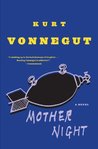
Kurt Vonnegut: Mother Night

Mother NightMother Night by Kurt Vonnegut
My rating: 4 of 5 stars

This is an altogether different beast than most other works in the Vonnegut cannon. That is not to say that it does not possess that same black humor, the same zany morals, and the same humanist views. That being said, it is distinctly lacking in some of the surreal, post-modern, narrative breakdowns that can be found in Breakfast of Champions or Slaughterhouse-Five. Nor does it possess any uniquely science fiction elements as are seen in The Sirens of Titan.

This novel, despite its minimalism, is altogether literary.

This is interesting because it shows something about both Vonnegut and genre writing as a whole. Yes, there are pieces as written by the likes of Arthur C. Clarke, those of the "hard sci-fi" standard. Technical novels that, though good, lack a distinct philosophy. Yet, we also have the likes of Vonnegut and Philip K. Dick and, to a lesser extent, Asimov. Writers who fused the pulp with the literary.

This novel proves that Vonnegut is a force in the same way that Nirvana's Unplugged performance solidified Cobain as a songwriter.

Now, onto the book itself, yes?

This book is the story of World War Two and the horrible atrocities that were wrought in the name of hate in conformity. In his seminal work, Slaughterhouse-Five, Vonnegut already told us there is no intelligent thing that can be said of war. Therefore, we must assume that the same can be said of hate.

This leaves us with the latter. Conformity is a big role in this novel. All the while the character of Howard Campbell is conforming to the roles that are placed on him. First is his an artist and a lover. He conforms to these roles with joy and with passion. However, due to the outbreak of World War Two, he finds himself conforming to the role of Nazi, propaganda agent.

This is done in direct response to another role he conforms to as American Spy. Secret one at that.

What does this all mean then, this conformity and exploration thereof?

Well, Vonnegut nails his own moral on the head. We are what we pretend to be. Howard Campbell pretends to be all these things, conforming to the roles with which he is given, and so he becomes this character. When at first he was a writer and a lover he was that fully and truly. However, when he spends his time writing slander against the Jews and working for the Nazi's. This is, ultimately, what he is remembered for.

This brings us to another point Vonnegut makes. We are remembered only for what art we produce. Indeed, this does seem true. Those that are most easily remembered are often the artists of generations past.

So then, when we are given these two points, what must we take away?

Perhaps we must take away that we should not pretend to be what we are not? Or, more cynically, if we must pretend to be anything, we must be sure that it is something history will look favorably on? That is, perhaps, the harder question.

Buy the Book Here: Mother Night: A Novel
 Or Try Audible For Free! Try Audible and Get Two Free Audiobooks

Thursday, August 27, 2015

V for Vendetta

V for VendettaV for Vendetta by Alan Moore
My rating: 4 of 5 stars

I wish I'd not seen the movie first. That isn't to say the movie isn't good, but it is so stripped and watered down.

Here, in this comic we have a complexity. We have the chance to see someone breed and abuse another human and use pretty words.

We ask ourselves, is this the price of revolution? This violent and ugly thing? And of course it is. Revolution is inherently ugly and violent.

However, whereas the movie shows us that V is a hero of culture, the comic shows us that, despite a visionary and revolutionary, he is scarred. His mind is broken and because of that we must ask if he is truly the great man he claims to be or if the idea he represents is a good, wholesome idea or just another form of fascism, only this time one that hides behind a mask.

The psychology of this character is more akin to an anti-hero than that movie representation. Here we have a man that faced horrors and yet did not come out the other side, reborn as a phoenix, but rather he slithers free like a basilisk.

The truth of it is, what Moore explores here is not simply the danger of conservatism, but also the ugly face the revolution can have. He hides V behind a mask for this very reason, for if we were to see his true face we would see that he, like his goals, are frightening. They are as a mirror to the world we live in and the steps we must take to claim the one we desire.

We see a man who, much akin to Lenin during the Russian Communist revolution, fights with his goal in mind. He does not concern himself with the short game, but rather the outcome of the war he secretly wages. In this sense he is a true revolutionary and here Moore forces us to see the steps we must take, forcing us to choice between the comfort of fascism and the dark waters of revolution.

View all my reviews

or buy the book here:  V for Vendetta

Wednesday, August 26, 2015

Batman: The Dark Knight Returns

Batman: The Dark Knight ReturnsBatman: The Dark Knight Returns by Frank Miller
My rating: 4 of 5 stars

Oh, Mr. Miller, what happened to you? Seriously man. This, your Ronin series, and Sin City are so fucking good. Maybe a little too big on the concept of manliness, but whatever, you blend noir in with finesse that I can't imagine.

Oh well, when we think too long on what could have been we get ourselves a bit angry.

So, here's the deal with The Dark Knight Returns, with this singular comic we have the modern Batman. Of course there are some issues with that. Chris Nolan's iteration has its flaws, yet it is clearly the best Batman we've had since the Tim Burton films.

Here, Miller plays with the idea of a world that is dark and angry. One of filth and grime. And one in which Batman has called it quits. The problem is, of course, that the system has already been completely fucked.

Remember when Heath Ledger's Joker went on and on about how Batman created him? Well, he did. Because criminals are a direct evolution of our compensatory system, when you introduce some crazy, fuck-up thing then you get criminals who operate as a foil. To put it another way, back before the Harrison Act, people could easily go and by stuff like Heroin in a drug store. This may sound crazy and backwards as hell but, the thing is, those people that could go buy regulated Heroin for low cost held jobs, supported their family, and were over-all productive members of society.

It wasn't until it became illegal for people to just buy Heroin in a store that we got addicts running into the streets to buy cheaply made, yet expensive drugs from gangs. This is where we get the modern portrait of the drug addict.

Anyway, the thing is, when Batman called it a night, the criminals didn't. So, therefore, we have this dark, fucked-up city and no Batman.

It is through this back drop that Miller examines the obsession with Batman and something Freud called the Death Wish. This concept of seeking death through crazy actions and the like is something we see the elder Batman embody by repeatedly speaking of ways in which he could die as well as how he feels younger.

This ties into another idea that Miller looks to explore, the idea of the obsession of Batman, his battle with his demons, and the reflection that a character like Two-Face manages to show us.

Miller plays with the psychology of Batman in a way similar to Alan Moore. He shows us that Batman is a character who finds himself obsessed by the dark creatures that sneak through his mind. Just as Two-Face can never turn away from his own personal darkness, neither can Batman help by snake through the darkness looking for an escape or else someone to beat to a damn pulp.

In this comic Batman really is the hero the city needs, not the one it deserves.

Really, the only downfall in this story is the Superman. The concept of Superman being a sellout to the government is interesting and, honestly, would have worked if it was given some more room to grown.

Oh well, you know what they say about could have been's.

View all my reviews

Buy the Book here:  Batman: The Dark Knight Returns

Or try free audible and get two free books:  Try Audible and Get Two Free Audiobooks

Sunday, July 12, 2015

The Myth of Superman

The Myth of Superman

The myth of Superman is one that embodies the idea of the American dream and experience. It is a myth of where we are in the reality of this country and where we imagine we could be. On one hand we are all interested in what we can do to improve our lot in life. Yet, on the other hand, we all feel the call to help others better themselves. However, what this myth shows us is the truth of this experience insofar as we are not willing to give up our own comfort for the sake of others. The myth of Superman is one that straddles the line between the real world and the imaginary, it is what shows us the hypocrisy of the American experience.
Superman, much like Captain American, has long been a symbol of American pride. He is an embodiment of morals, of the American sensibility, and all the great things that make the American people the best on the planet. His is a humble farm boy, hardworking, modest. Yet strong and powerful. More so, Superman is Christ-like in his appearance and his message. He is a statement against consumerism, though he lives in the world we live in. Superman is the mirror to our world, at once a myth and a focal point for who we are and want to become.
Superman appears to us a babe from the heaves and, as pointed out by Gustav Peebles in his own essay, God, Communism, and the WB, he is sent to us, the only son of Jor-El. Yet, the Christ analogy does not end there with Superman, as in is pointed out by Peebles. In one episode of Smallville, a series about the upbringing of Superman, “Clark appears on a crucifix,” (God, Communism, and the WB, location 1338). In yet another episode he is, “bathed in a halo of light,” (location 1338). In this way it is plain to see that Superman is no mere man, but he is a Christ figure, one to which we look up to. One that inspires us not to follow him, but to be like him.
Yet, how does this Christ analogy show us Superman as American? Superman is not merely a symbol used as Christian propaganda, but rather a display of the moral power that American culture hopes to breeds. On the surface, yes, we see Superman as the boy that fell from the stars to save us. Yet, more than anything else, Superman desires to be just like the average person. This desire to fit in is seen not in Superman, but in Clark Kent himself. A mild mannered, weak man who works a menial job, always trying to restrain himself, repress his own culture. Even when crusading under the guise of Superman, Clark looks not to be a messiah, but a force of good, one with which we aspire to be. This is something that we as Americans look to experience, look to achieve.
It is through this Christ analogy that we see the world Superman wants to present to us. A human being of moral upstanding who inspires us to live happily and without a desire for possession, but rather for the helping others. This can been best illustrated in the seminal Superman comic, “What's So Funny About Truth, Justice, And The American Way,” written by Joe Kelly. In this legendary comic Joe Kelly has Superman replaced by a more radical group of superheroes. This group does not hesitate to kill those who do wrong and will not hold back from causing destruction. It is in this comic we see Superman deal largely with the real world, one in which people want safety and want the easy answer.
Yet, through this story we see Superman trick the world at large, destroying this radical group of superheroes, killing them. Here we see the shock of what the real world is when met with hope. It is here we find that, in the eyes of Superman, the American way is the way in which we strive to better each other and, as John F. Kennedy once said, doing things not because they are easy, but because they are hard.
Yet this is not the only way in which we see that Superman is a character that attempts to represent the American experience. When we see the character of Lex Luther in Superman, whether it be through the comic books, the films, or the cartoon, we are presented with a man that seemingly embodies an aspect of the American experience. After all, Lex Luther himself clawed his way to the top, making a success out of himself. He owns a successful company in Metropolis, he rich, can own whatever he wishes, and is a powerful, feared, and respected name to one and all. However, despite this money, this power, and this accusation of capital, Lex Luther is a bitter, angry, and despicable man.
At all turn Lex Luther attempts to undermine and destroy Superman, who, by comparison, is a happy, loving, an honorable man. The argument could be made that, perhaps, Lex Luther wishes to undermine Superman because his worries of an over-dependence on his power, that with such a powerful figure in the public eye there will be no progression. Yet, this view of their struggle is too simplistic, too convenient. The power struggle between these men is one based on class, one based on what we want to be, what we believe we can become and what we are at are darkest.
Superman is a working class man, a farm boy, and someone that, despite his power, holds no interest in capital or in money. Rather, Superman and is concerned with helping better his fellow man. He wishes to learn from his cultures mistakes and be a symbol of hope to his adopted culture and planet. Lex Luther is, of course, the very antithesis of this point, a counterbalance to the radical left that Superman represents.
In this way, Superman is a representation of the world that we live in. We must work, we must try to do what we can to get by. Yet, unlike Lex Luther, Superman does not spend time constantly trying to gain what he does not have. Rather, Superman lives in the real world, yet works for the world in which he wants to see. This dichotomy between the real and the imaginary is a thing that any American can experience. In the real world we always search that imaginary thing, that perfect world where everything is just, just as Superman himself does.
This dream that Superman seeks is exemplified best in this excerpt from a speech give by President Obama, “What is unique about America is that we want these dreams for more than ourselves - we want them for each other. That's why we call it the American dream” (Obama, Speech on the American Dream). Both Superman and the president believe the same thing in that the experience of every American is one where they want the best for themselves. The best jobs to support their families, the best education for their kids, and the best health care for when they are sick and, deep down, many of us want the same for others. The struggle, however, comes from the desire to want things to be easy on the level of the individual, even when that same sense of ease cannot be applied to everyone. In this sense Superman shows us the hypocrisy we all experience in the quest to reach this dream while also holding true to the old communist mantra, “each according to their ability, each according to need.”
Yet, even in this struggle we see the merging of two different and strange beliefs. On one hand we have Superman as the figure of Christ. The boy who fell to Earth to save us all. Then, on the other, we see Superman as the hero of the working class. A man obsessed not with wealth or anything so petty, but with bettering his fellow man and leading them to a better world. As noted by Gustav Peebles when speaking of Superman, “This odd fusion of beliefs recalls a time inverted from our own. When the political left had not yet entrenched itself in its cosmopolitan enclave and the political right had not yet entrenched itself in the countryside” (God, Communism, and the WB, location 1362).
This very fusion is one uniquely American. At once it calls for us to take up the cross and give love to Jesus and yet, at the same time, it calls on us to renounce our materialistic views. Superman is a symbol that calls us to free ourselves and, in that sense he is a perfect show of the American experience. He is, at once, an idea that we all wish to aspire to. Yet, at the same time, he is a mocking reminder of the hypocrisy of the American culture that calls on us all at once to be pious and giving, and yet greedy and impious.
Superman, much like ourselves, lives in the real world. One in which there is greed and hate and disgust. One in which people do not always do what is right or just for those around then, but rather what is right or just for themselves. Yet, all the while, he represents the America we all want to live in, the one we write the songs about. The myth of Superman, as Gustav Peebles states, “lies behind the hidden heart of American folklore and philosophy.” This is the truth behind Superman. He is the line between what we want to be and who we are. The mirror we look into in the morning so that we can see every flaw and, perhaps, his is the image that shows us just how much better we can be.


Works Cited
Obama, Barack. “Speech on The American Dream.” Bettendorf, Iowa. 7 November 2007.
Peebles, Gustav. “God, Communism, and The WB.” The Man From Krypton. Dallas, Texas: Smart Pop, 2006. Book. Location 1338 to 1345.
Peebles, Gustav. “God, Communism, and The WB.” The Man From Krypton. Dallas, Texas: Smart Pop. 2006. Book. Location 1362 to 1370.


Monday, May 25, 2015

Kurt Vonnegut: Breakfast of Champions

Breakfast of ChampionsBreakfast of Champions by Kurt Vonnegut
My rating: 3 of 5 stars

THere are a large number of people who aren't too keen on Vonnegut, and for reasons that I can easily understand. On one end Vonnegut is a science fiction/speculative fiction master. He was a moral force, so much so that when speaking of war in his masterpiece, Slaughterhouse Five, he said, "there is nothing intelligent than can be said about war."

Damn.

That lone sentence is so powerful and provocative it hurts. Vonnegut says there, in a single sentence, what we all wish to say of violence, destruction, death, and hate. He does it so simply and so easily, as if that were the only thing to say.

Yet, on the other hand we have Vonnegut as the postmodernist. The man who plays with form and structure. The man who flashes from character to character, exposing details about each of them and laying it all bare.

This second side is the one that alienates people.

To many readers Vonnegut seems to be pretentious and nonsensical, yet one need only look at this work or Slaughterhouse Five to see just how important this style of postmodernism is.

Firstly, I will say this. When Vonnegut writes of a car salesmen he does so, in part, from experience. It is because of this that we can feel the realism, the pressures of the world and of society that so press on this man.

Now, Vonnegut is in this story is God. This may seem like an egotistical stance to take, yet, what are authors if not Gods?

It is because of this singular concept we get Vonnegut's brand of postmodernism. He is not merely recounting events and allowing them to be revealed through the actions of the characters, as we are so often accustomed. Instead, he is the creator himself, the one that knows the inner workings of their minds. He knows their past and their future and yet he is condemned only to watch.

This is equal parts genius and comedic, a thing that can be said of much of Vonnegut's works.

Yet another theme at work here is the that, when facing ourselves in the mirror-or leaks-we have only ourselves to face. We are not seeing a reflection but another version of ourselves, one that reflects us. Thus, when Vonnegut breaks the barriers of his world and asks of himself, "You're afraid you'll kill yourself like your mother, aren't you?" He has no chance but to answer, "yes."

Vonnegut's work is one that examines the human condition at its strangest and worst. He reflects us as we are and as we fear we will become and though there was a narrative drag in the story around the middle, this story is all about reflection and how we much be honest with ourselves. And so again, when the author confronts Kilgore Trout and asks him what he desires, he has no choice but to say, "to be young again."

View all my reviews or buy the book here: Breakfast of Champions: A Novel

Or try some free audible: Try Audible and Get Two Free Audiobooks

Friday, May 22, 2015

Jim Thompson: The Killer Inside Me

The Killer Inside MeThe Killer Inside Me by Jim Thompson
My rating: 4 of 5 stars

Jim Thompson's career as a pulp crime writer left him without much money, yet he was well renowned among those who were attracted to the demented mind of a serial killer.

Stanley Kubrick had him as a writer on "The Killing," (albeit, not giving him a writers credit) and has called this novel the most disturbing look at a disturb mind. I could not agree more.

Thompson's character of Lou Ford is a reflection of abuse. A character who has suffered at the hands of another and, years later, after having had these feelings of abuse fester like a wound, Lou Ford has become a killer.

Ford is smart, too smart to just be a cop. He reads often and wants to be a doctor, though he fears doing so would expose the monster he is.

He also has a girlfriend, one that he keeps primarily for appearances, but as the story progresses we see the human side of Ford.

What truly makes this novel interesting is just how brutal it is. How unflinching it is at it tackles the concept of sexuality, morality, police brutality, and physical and sexual abuse.

Even today, many have a penchant to blame victims of physical and sexual abuse. "You shouldn't have walked down that alley,"

"Well, wearing that you were asking for it."

Those same concepts are at play here and feed into the psychology of Ford. He is not some deranged maniac who kills for no reason except that he enjoys it. Nor is he some horrible misanthrope. There are many times where he feels himself at odds with the monster inside.

Lou Ford is a product of his upbringing and his environment, just as we all are and Thompson handles these complex themes with grace and finesse.

And if you need more, if it wasn't for this book you wouldn't have Dexter. Hell, Dexter is, at best, a reflection on a shallow pool by comparison to Ford.

View all my reviews or buy the book here: The Killer Inside Me

Wednesday, May 20, 2015

Fairies Moon: Page One Preview

   It happened, as most wonderful and fantastic things do, in the smallest and most insignificant of towns. Such was the case with the town of Farrow, a lovely little place that finds itself nestled in the heartland, where the hills roll on in endless green and the trees tower above as sentinel towers, ever watchful. Where bluebells, lilies, roses, nightshade, and a garden of other lovely colors dot the land, filling it with that picturesque scenery only found in a painters paintings or a poets poems. It was here, amongst all of this strangely perfect beauty, that the fair people(who seem to be much fairer than other folk) conduct their strange rituals of dancing before odd colored fires in terrific masks, chanting their odd chants.

  The fair townsfolk pull out the fulness of a feast prepared throughout the day during these festivals, conducted only when the moon bares its naked glory to the world. These feasts are filled with the most wonderfully cooked pheasant, with purple plums and pickled delights of all kinds. Rare fruits, brightly colored and possessing the illusion of shifting shades of blue, green, and violet, known as Stardust, populate every plate. Their sweet and intoxicating smell waft through the village, wisps of wind carrying them along and causing every person to salivate in anticipation for this slightly hallucinogenic fruit.

  This scene of townsfolk of all shapes and sizes carrying out tray after tray of beautifully prepared food was what Lisanna Limly returned to, dressed in a fine white lace dress with an academic posture about her. She had been gone for a solid five years to study far and abroad and now, looking out at the strange ritual that she had spent the majority of her life participating in, she felt nostalgia bloom within her. They were, she thought with a lazy smile gracing her lips, glued to their innocent superstitions and frivolous magics. They would never know, as she did, the origin of their words and their importance.

  But, she thought mildly, there is always a surreal comfort in finding a place exactly as it was when you left it.

  With one long and confident step Lisanna walked out into the chaos and called out to a man in black suit and a tall black hat, causing him to drop the tray of food that he was carrying, sending fruit and meat exploding through the air and skittering across the ground.

  “Ma' Lord, girl! Don't go scarin' a man like--wait a damned second...is that you little 'Sanna?” asked the black hatted man, the anger pouring out of his voice as quickly as it had come.

  “Yes it is, Mr. Rutter. It is nice to see you're still as quick to yell as you are to smile,” she said, flashing him a full white smile.

  Carlyle Rutter gave her a broad, toothy grin and said, “Well, ya couldn't have picked a better time to come home, could ya?”

   Lisanna shrugged, “I suppose so.”

  “Now don't go around actin' so indifferent! This is everyone's favorite time-a year! Now why don't you head off an' go find little Neil? I remember he was awfully found of you and he'll be jumpin' and shoutin' when he sees you've come back all grown up and twice as pretty.”

   Lisanna's smile grew wider and brighter, “I suppose he might. Where is he?”

  “He ought to be floatin' around and takin' care of gathering up all the proper salts and dusts. He's apprenticing under the town alchemist, if you can damn well believe that!” exclaimed Carlyle, shooing her away.

   Lisanna strode in the direction of the apothecary, muscle memory taking her where she needed to go. As she went she could hear Carlyle shouting his head off and giving general hell to a couple of boys he had managed to con into cleaning up the mess that he had made.


  It all made Lisanna gloriously exultant. She had missed the chaos that this small town managed to get swept up in and the sweet aroma of the Stardust fruit mixing with the bitter smells of brewed potions, burning salts, and magic dusts of all kinds.

Tuesday, May 19, 2015

Does Science-Fiction Matter?

Very recently Simon Pegg made some comments about science-fiction and fantasy novels and movies that, more or less, said that all of this over-saturation of comic book movie and science-fiction action film has dumbed down the whole of cinema. Naturally, many people have been hurt by these remarks. After all, Pegg is a nerd hero to many and for him to decry something that so many enjoy, well, it is fucking painful to see.

However, I do not intend to break down or explain his statements. I do not desire to argue, though it may well seem that that is what I am about to do. No, I merely wish to ask, is science-fiction and fantasy as moving or meaningful as the classics, both in regards to film and the novel.

Let us first look at the classics in questions. Before recent memory there was not an overabundance of comic book, superhero, science-fiction/fantasy film. That is not to say that they did not exist. Tim Burton's Batman, a film of over twenty years of age, is of course one of the most beloved superhero movies to ever exist. Yet, Burton does not direct this movie in the style of today's superhero blockbusters. Rather, he brings the training and eye of a classic filmmaker to the table, allowing it to transcend the bonds of the superhero movie and transform into a noir character study.

Yet, barring such examples, what movies really made a big impact on us? Why, it was films such as The Godfather, or Taxi Driver, or Rock, or even Fight Club for a more recent example. These were dark and gritty films that focused on the real as well a the surreal. They forced the viewer into a dark world and demonstrated exactly what the repercussions of a police sate could be, or the importance of personal freedom, of the dangers of a government that spies on us at all turns. They were character studies and were political by nature.

In short, these films challenged the audience to think. There was no other way but to think when you watched such films.

Then, in the blink of an eye, things began to change and that change was called Star Wars. Now, I will not say that Star Wars does not play with themes as it most certainly does, yet even Star Wars is a departure from the other films Lucas had made at that point in his career.

So, what was it about Star Wars that changed everything then? And, further, is there anything wrong with this change?

Well, Star Wars is, in many regards, the film equivalent to Tolkien's Lord of The Rings. Both of these creations had multiple influences, some within the genre they inhabit and some outside of it. However, they were both trying to capture something grand, something that was perhaps lost. Whereas Tolkien hoped to recreate the power and depth of the long lost Epic, Lucas hoped to recapture the spark that was the Pulp story.

Both succeeded in their own rights and both are well loved for good reason.

However, just a Tolkien spawned the likes of Robert Jordan, Lucas wrought his own imitators (which, ironically, was himself in the form of hi prequel films).

Since the creation of such things we have been left with films that try to grasp at the depth and grandiosity of their inspiration, and yet somehow fall short. Yet another parable can be seen in the comic book industry as, since the creation of Watchmen and V for Vendetta, many have sought to get at the heart of Moore's work and yet they always miss out on his literary mind.

So, now that we see the history the question remains, do these new pieces of science-fiction and fantasy hold any water?

On the surface, no. They are pale imitations in most cases and at worst you are watching a Micheal Bay film. However, in many cases, one only need look a little deeper to see that there genres still have much to say and teach.

Without calling out the obvious names of Whedon and Gaiman, I will attempt to show that there are still a great many great things coming from the genres.

In terms of film, with the Marvel universe exploding ever outward, it is a wonder that something a brilliant as Captain America: Winter Solider could be birthed. Simply said, this film expertly tackles the themes of big government, of the danger of surveillance and of the militarization of the police. These are very topical and talked about social issues that we face today and for any movie, let alone a fucking comic book movie, to tackle them with any sort of grace is a miracle. Captain America does it with ease and shows that following orders leads us down a rabbit hole that may well bring our doom.

Even Iron Man deals with the concept of responsibility of the justice system, a theme we will see further explored in the upcoming Civil War arc of films, just as has been done in the Civil War comic books (like below).

Even outside of the superhero movie we have films like Ex Machina that tackle the complex issue of artificial intelligence and what makes someone human. Those Dickan (see: Do Androids Dream of Electric Sheep?) themes are ones not often tackled in any form and are best examined in genre films and literature.

In regards to books we have the likes of Susanna Clarke, writer of the elegant and excellent Jonathon Strange & Mr. Norrell, a novel that inhabits the realm of fantasy yet still manages to be profound, well written, and expertly researched. Hell, even Gaiman proclaimed awe when first meeting and reading Clarke's work.

The likes of Patrick Rothfuss also hold onto the pillars of great fantasy that, be it the authors intent or otherwise, manages to tackle hard themes in clever, subtle ways. Then, for your science-fiction fix we have the likes of William Gibson who, even now, uses his strange and powerful language to tackle themes of technology and our dependance on it, drug use, street life, and cooperation corruption and power. Or Neal Stephenson who tackles similar themes, yet with the same zeal and bat-shit crazy attitude of the likes of comic book master Warren Ellis.

This is, of course, not to say that the classics are not masterful or profound. Or even that all genre film and fiction is a masterwork that deserves praise. Far from. What I am merely saying is that science-fiction and fantasy inhabit a very special world in which they can entertain as well as engage, which is a thing of beauty and rarity.

Were it not for the fantasy slant in Wim Winders film Wings of Desire we would not find any aspect of it to be entertaining as it is, yet were it not for his literary mind and skillful direction we would find that it lacks the depth that makes it such a masterpiece (in fact, if you want proof of that, go watch Wings of Desire and then watch the American butchering of it, City of Angels. No joke),

Everyone wants to be entertained, at least to some extent, yet it is possible that we can think while we are entertained. In fact, it is imperative that both happens at once because, lets face it, some people are not interested in art films. So, yes, there is an oversaturation and a dumbing down that can be linked to genre film, yet there is also an untapped potential that peaks through from time to time and shows that science-fiction and fantasy is not merely an escape, but rather a different route to the same end.

Get the Civil War comic here: Civil War

Or try audible free here: Try Audible and Get Two Free Audiobooks